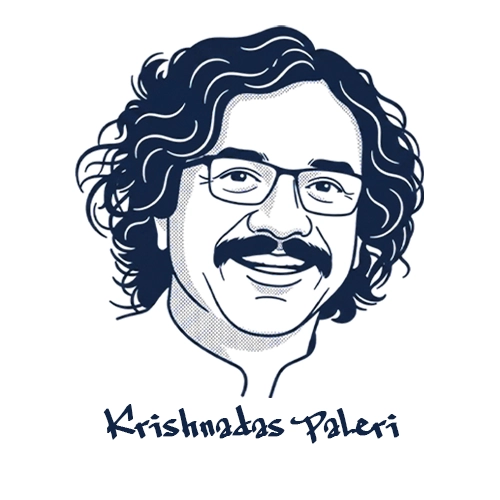
Who is Krishnadas Paleri?
Why I Made Mathematics Visible
I am Krishnadas Paleri, a teacher from Kasaragod, Kerala, whose work has grown through Mathematics education, teacher mentoring, environmental learning, films, curriculum work, and public education. For many years, my classroom was not only a place for lessons; it was a space where children taught me how learning really happens.
I worked with children who were curious, silent, confident, hesitant, fast, slow, playful, afraid, and deeply observant. Some understood quickly. Some needed time. Some could solve a problem orally but struggled to write it. Some could copy every step from the board without understanding what they had written. These children shaped my teaching more than any textbook.
That is why I began to think seriously about one question: How can Mathematics become visible to a child before it becomes a written answer?
The Problem I Saw in Mathematics Learning
Many children do not dislike Mathematics because the subject is impossible. They fear it because they meet it too early as symbols, rules, and corrections. A child is asked to write, calculate, and remember before getting enough time to see what the idea means.
Place value becomes columns. Fractions become numbers separated by a line. Area becomes a formula. Measurement becomes a unit. Multiplication becomes a table. But if the child has not seen grouping, sharing, covering, comparing, or measuring, the written form remains distant.
I felt that Mathematics should not begin with pressure. It should begin with experience. Children must be allowed to see, touch, arrange, count, compare, measure, ask, make mistakes, and explain. Only then will written Mathematics carry meaning.
Why I Chose Visible Mathematics
For me, visible Mathematics means making an idea available to the child’s eyes, hands, body, and speech. It is not a show. It is a teaching necessity.
When children use place value kits, Jodo-cubes, abacus, measurement tools, puzzles, activity cards, Maths Board, Maths Magic, and simple classroom objects, they begin to understand Mathematics through action. They group objects, separate them, compare quantities, build patterns, test answers, and speak about what they notice.
A child who is silent during a written exercise may become active when materials are placed before them. A child who fears mistakes may try again when the answer can be changed, rebuilt, or discussed. A child who cannot explain in formal language may first show understanding through action.
This is where learning begins to change.
Mathematics Labs and Classroom Practice
The Mathematics Lab became one of the most useful spaces in my work. It helped children move from listening to doing. It also helped me understand their thinking more clearly.
In a regular notebook, a wrong answer may hide the child’s actual doubt. But when a child handles material, the teacher can see where the confusion begins. Is the child counting wrongly? Is the child not understanding place value? Is the child comparing without a reference? Is the child memorising a step without seeing the relationship?
These observations helped me prepare better activities, remedial worksheets, group tasks, and learning kits. During the COVID period, the idea of the Home Mathematics Lab became important because children needed learning materials and support inside their homes. Mathematics had to reach them even when classrooms were closed.
From Fear to Participation
One of my strongest beliefs is that a child must not be judged before being understood. Many children become afraid of Mathematics because they are corrected too quickly and listened to too little.
In my classroom, I wanted children to participate before expecting perfection. Participation can mean arranging objects, asking a doubt, giving a wrong answer, trying another method, helping a friend, explaining a pattern, or saying openly, “I did not understand this.”
When children participate, the teacher gets a chance to guide them. When they remain silent, the difficulty grows unseen.
Visible Mathematics helped children move from fear to participation. It gave slow learners a way to enter the lesson and gave advanced learners a way to think deeper.
Nature Also Helped Me Teach
My work in environmental education also influenced my Mathematics teaching. Nature taught children to observe carefully. A river, a wetland, a tree, a shadow, a leaf, or a field visit can become a learning space.
Children can measure shadows, compare leaves, observe patterns, count species, record changes, discuss water sources, and understand the connection between environment and society. When children learn from nature, they begin to see that knowledge is not limited to the classroom wall.
This is why I connected Mathematics, environmental learning, field visits, sacred groves, wetlands, and community observation wherever possible. A child who learns to observe nature carefully also learns to observe Mathematics carefully.
Sharing the Method with Teachers
When I worked with teachers through training sessions, Mathematics camps, SSA work, SCERT-related activities, NCERT-linked graded learning material, and public Mathematics sessions, I carried classroom-tested methods with me.
I believe teacher training should give teachers something they can use. A good session should not remain only as a speech. It should offer activities, materials, questions, examples, and practical classroom possibilities.
Teachers do not always need expensive resources. Many Mathematics ideas can be taught using simple objects, paper, sticks, stones, seeds, cards, measuring tools, and locally available materials. What matters is the clarity of the activity and the teacher’s attention to the child’s thinking.
Conclusion
I made Mathematics visible because children deserve understanding before memorisation. They deserve time to handle ideas, make mistakes, discuss answers, and build confidence. A child should not feel that Mathematics is a closed room meant only for a few. It must become a subject they can enter through activity, observation, reasoning, and practice.
My teaching began with the child, not the formula. The formula came later, when the idea became clear.
Associate with Krishnadas Paleri
Schools, teachers, education departments, training institutions, Mathematics clubs, children’s organisations, environmental groups, and public education platforms can associate with me for Mathematics mentoring, teacher training, Mathematics Labs, activity-based learning sessions, student camps, environmental learning, educational film discussions, and public education programmes.
The purpose is simple: help children understand with confidence, help teachers use practical methods, and help schools connect learning with life, nature, and society.